
Los medicamentos GLP-1 como Ozempic, Wegovy, Mounjaro y Zepbound han cambiado lo que es posible para la pérdida de peso. Las personas están perdiendo 50, 100, a veces 150 libras, a menudo más rápido de lo que lo harían solo con dieta y ejercicio. Eso es una verdadera victoria para la salud. También trae una realidad física de la que no se habla lo suficiente: la piel y los tejidos no siempre siguen el ritmo de la balanza.
Hemos pasado casi dos décadas apoyando a las personas durante la recuperación postquirúrgica. Ahora estamos viendo a un nuevo grupo aparecer con las mismas preguntas que nuestros pacientes quirúrgicos siempre han hecho: cómo apoyo mi cuerpo a través de este cambio y qué sucede después.
Por qué la pérdida de peso con GLP-1 cambia tu piel
La piel tiene cierta elasticidad, y esa elasticidad depende de la edad, la genética, la cantidad de peso perdido y la rapidez. La pérdida de peso tradicional tiende a ocurrir en meses o años. Los medicamentos GLP-1 pueden producir resultados dramáticos en un período mucho más corto. La piel y el tejido conectivo subyacente a menudo no tienen tiempo para retraerse al mismo ritmo que la capa de grasa desaparece.
El resultado es piel flácida o colgante, más comúnmente alrededor del abdomen, la parte superior de los brazos, los muslos y la espalda. Es una de las preocupaciones más buscadas entre las personas que están en medio de un plan de pérdida de peso con GLP-1, y es una razón importante por la que muchos finalmente buscan procedimientos de contorno corporal como abdominoplastias, levantamientos de la parte inferior del cuerpo, levantamientos de brazos y levantamientos de muslos una vez que su peso se estabiliza.
Dos momentos en el camino donde la ropa de compresión es importante
Mientras aún estás perdiendo peso. Las prendas de compresión no tensarán ni eliminarán la piel flácida. Ninguna prenda puede hacer eso; solo la cirugía aborda directamente el exceso de piel. Lo que una capa de compresión de calidad puede hacer durante esta fase es ofrecer soporte y una silueta más suave a medida que la forma de tu cuerpo cambia semana a semana, junto con la comodidad de una presión suave y uniforme en áreas que se sienten diferentes a como solían hacerlo.
Después de una cirugía de contorno corporal. Aquí es donde la ropa de compresión deja de ser opcional. Los cirujanos la requieren rutinariamente después de procedimientos como abdominoplastias, levantamientos de la parte inferior del cuerpo, levantamientos de brazos y levantamientos de muslos, los procedimientos exactos que muchos pacientes con GLP-1 persiguen una vez que han alcanzado un peso estable. La compresión en esta fase apoya la cicatrización del tejido, ayuda a controlar la hinchazón y ayuda a que el resultado final tome la forma para la que fue diseñado.
Qué buscar en una prenda de compresión después de una pérdida de peso importante
La piel que ha pasado por un cambio de peso rápido o una cirugía es más sensible de lo normal, por lo que la tela importa tanto como el ajuste.
- Tejido sin látex y antimicrobiano. Reduce el riesgo de irritación en la piel que ya se está ajustando a muchos cambios.
- Sin encaje ni costuras ásperas. Comodidad en las áreas sensibles, especialmente en las primeras semanas de recuperación.
- La etapa adecuada para donde te encuentras. Las prendas con cremallera o cierre de gancho y ojo se usan típicamente en la etapa temprana de recuperación, cuando doblarse o estirarse para ponerse una prenda aún no es realista. Las prendas sin cierre se usan una vez que la hinchazón ha disminuido y la movilidad ha mejorado. Esto se trata del tipo de cierre y el momento, no de una diferencia en la fuerza de compresión.
- Cobertura específica para tu procedimiento. Una abdominoplastia requiere una prenda diferente a un levantamiento de brazo o un levantamiento de muslo. La cobertura de cuerpo completo no siempre es la opción correcta, la prenda debe coincidir con el área que fue tratada.
Cómo Isavela apoya este camino
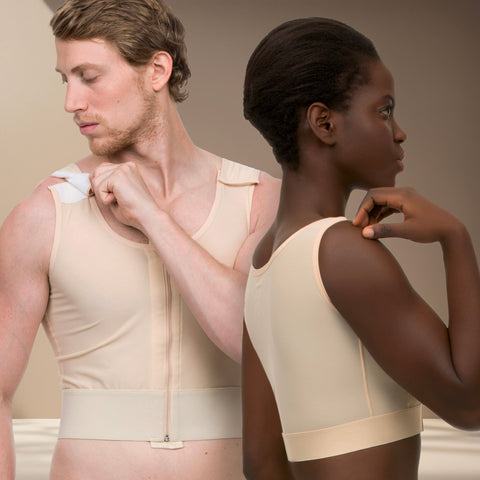
Tenemos categorías de prendas diseñadas para esta gama exacta de necesidades: bodys completos para procedimientos abdominales y de la parte inferior del cuerpo, fajas para el soporte de la cintura y la cadera, mangas para levantamientos de brazos, chalecos para trabajos en la parte superior del cuerpo y prendas diseñadas específicamente para hombres, ya que la pérdida de peso con GLP-1 y las cirugías que a menudo le siguen no se limitan a un solo género. Cada prenda Isavela está libre de látex, es antimicrobiana y está fabricada sin encaje, los mismos estándares que mantenemos desde 2008.
Si no estás seguro de qué etapa o estilo se ajusta a tu momento, nuestra guía de tallas y equipo están ahí para ayudarte a encontrar la correcta en lugar de adivinar.
Algunas preguntas frecuentes
¿Puede una prenda de compresión eliminar la piel flácida de la pérdida de peso con GLP-1? No. La compresión puede brindar comodidad y silueta durante la transición, pero solo la cirugía elimina el exceso de piel. Si la piel flácida es una preocupación importante, eso es una conversación para un cirujano plástico certificado.
¿Cuándo debo empezar a usar compresión después de un procedimiento de contorno corporal? Ese cronograma proviene de tu cirujano, no de una guía general, ya que depende del procedimiento específico y de tu recuperación individual. La mayoría de los pacientes pasan de una prenda con cierre a una de tipo "pull-on" a medida que disminuye la hinchazón.
¿La ropa de compresión Isavela es adecuada para pieles sensibles después de la pérdida de peso? Sí. Nuestras prendas están libres de látex, son antimicrobianas y sin encaje, lo cual es de suma importancia cuando la piel se está ajustando a un cambio significativo o cicatrizando de un procedimiento reciente.
Esta publicación es solo para información general y no sustituye la orientación de tu médico o cirujano. Siempre sigue las instrucciones específicas de tu proveedor para el uso de prendas de compresión durante la recuperación.